


Flanders Scientific
XMP310C
XMP310C
Prices exclude VAT
In Stock
Couldn't load pickup availability
The XMP310C is a more compact and affordable version of our popular XMP310. It uses the same industry leading 31.5" UHD resolution QD-OLED panel as the XMP310, but in a form factor that is better suited to many broadcast control rooms, OB trucks, and even some post production applications.
Key Differences Between XMP310C and XMP310
- Simplified 5-way controller on back of monitor instead of front facing keypad
- No speakers, though an Audio Out is still provided
- No Processed Monitor Outputs, though clean loop throughs are still provided
These differences result in a reduction of size, weight, and cost. Overall monitor height is reduced by 1.375 inches (3.5cm) and there is a weight savings of over 1.75 lbs (0.8kg). While the XMP310 is still the go to option for on-set applications, where the keypad and processed outputs have great utility for operators, the XMP310C is a great solution for applications that either require less frequent access to menus / functions or where remote control of the monitor is likely to be used instead.
Learn more about the XMP310C at FlandersScientific.com


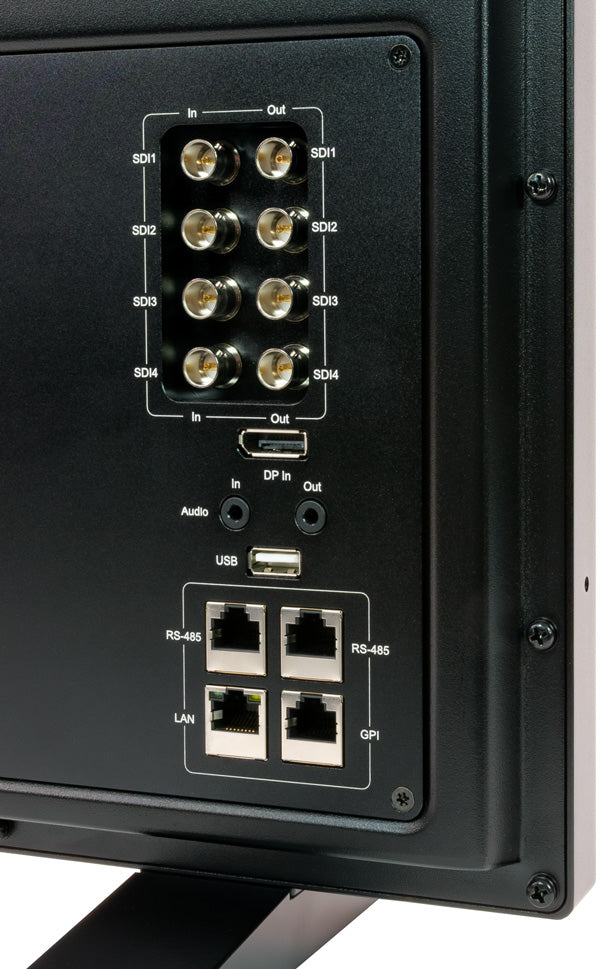
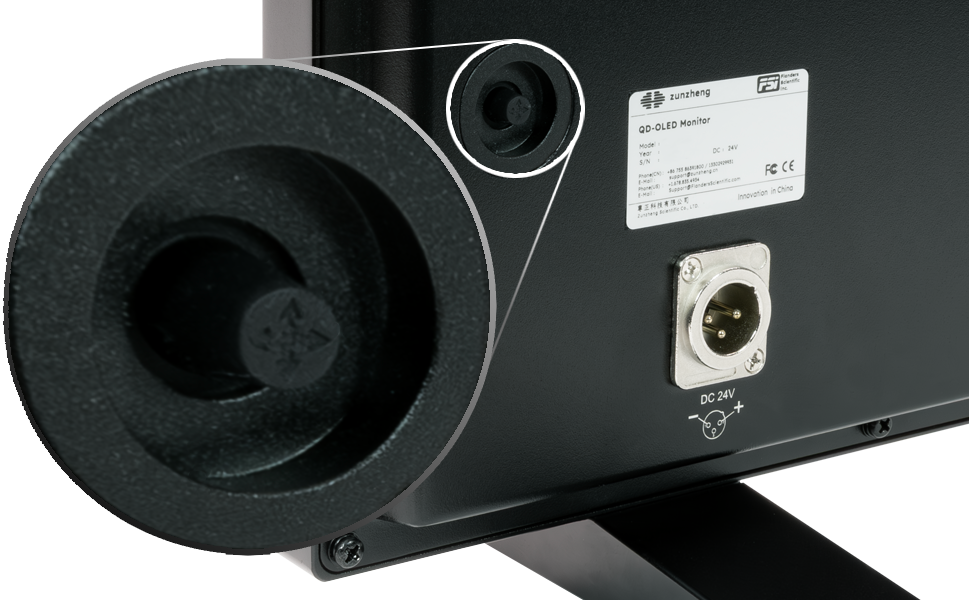
31.5 QD-OLED HDR Mastering Monitoring
The XMP310C is a 31.5 UHD resolution HDR and SDR reference mastering monitor built around a groundbreaking new QD-OLED panel featuring 1000nits peak luminance, ~1,500,000:1 contrast, and our widest color gamut to date.
Color Management
-

AutoCal
All FSI monitors come pre-calibrated from the factory and the XMP310C also features highly accurate volumetric Auto Calibration making it incredibly easy for clients to recalibrate the display over time.
-
Third Party Calibration
The XMP310C is also compatible with popular 3rd party calibration solutions including Calman and ColourSpace. Quickly and easily perform your own custom 3D+1D LUT based calibration with any program capable of saving into FSI’s calibration LUT formats.
-
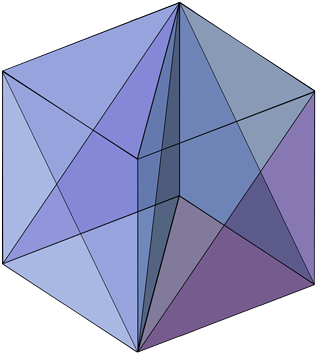
Advanced Tetrahedral LUT Processing
The XMP310C utilizes advanced tetrahedral LUT interpolation delivering a higher degree of precision with better on screen performance than simple trilinear LUT interpolation.
The QD-OLED Advantage
-
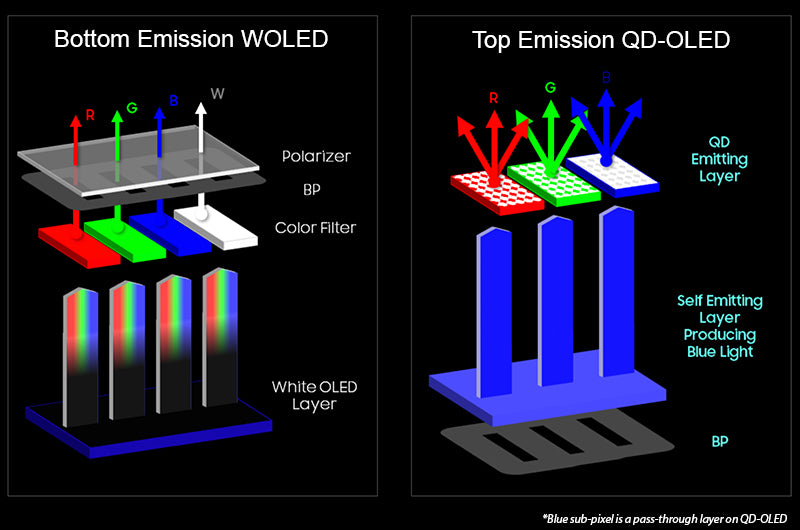
Advantages Over Other OLED Technologies
Other available OLED technologies are either too dim for HDR mastering or suffer from very significant volumetric collapse due to their non-additive RGB+W sub pixel structures making them unsuitable for HDR use cases that demand color accuracy. QD-OLED is truly RGB additive for white, thus avoiding color volume limitations.
-
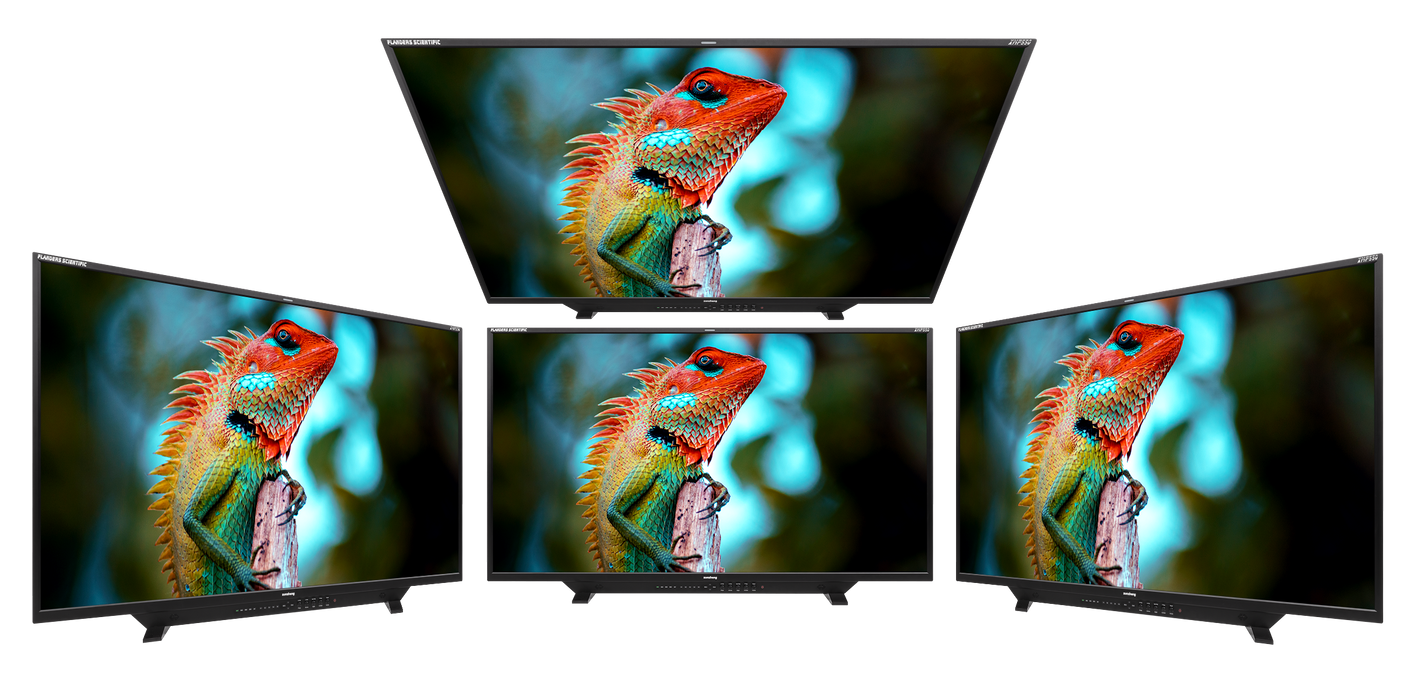
Exceptional Off-Axis Viewing
The XMP310C has the widest viewing angle, with the least off-axis contrast and color shift, ever featured in an FSI display. So not only will a colorist’s clients benefit from being able to view a reference image on a large screen they will also have the flexibility to view the image from anywhere in the room without having to worry about the off-axis limitations often seen in other display technologies.
-
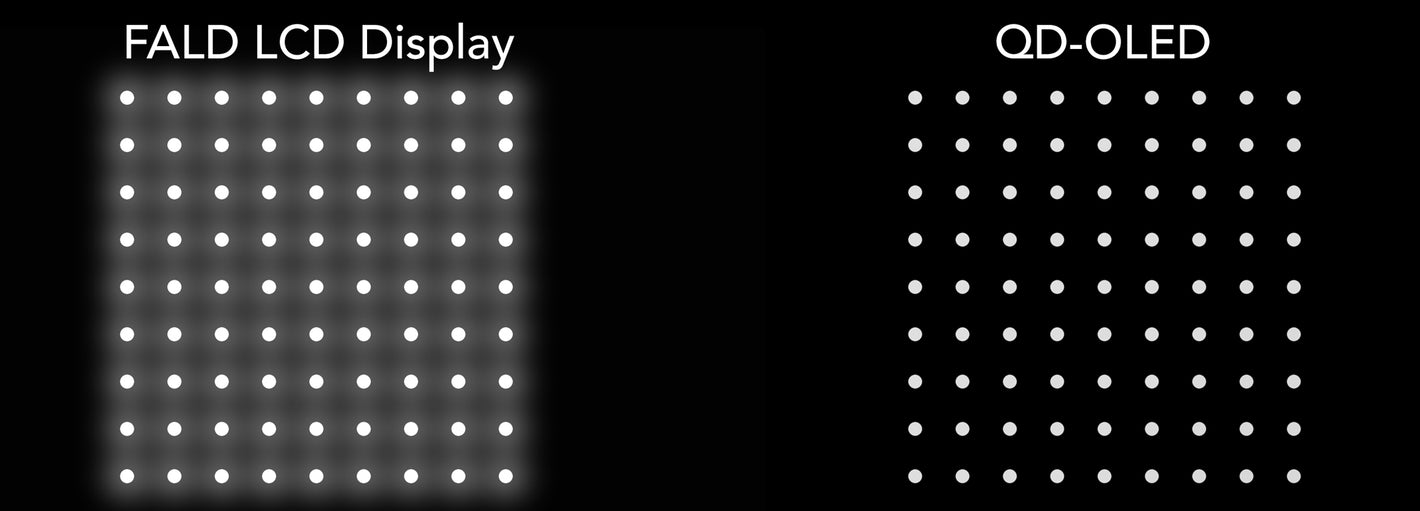
Advantages over FALD LCD
The XMP310C’s accurate per pixel level luminance control means true black levels at all times with none of the small bright objection or motion artifact limitations found on FALD (Full Array Local Dimming) LCDs. The per pixel emissive design of the XMP310C’s QD-OLED panel guarantees exceptional simultaneous contrast with all varieties of content.
While the amount of halation can vary greatly between FALD LCDs, all FALD systems will show at least some degree of raised black levels and haloing when rendering a high contrast image like this example of a white circles on a black background graphic. The XMP310C’s QD-OLED panel on the other hand can render these types of very bright white highlights while maintaining the intended deep black background. -
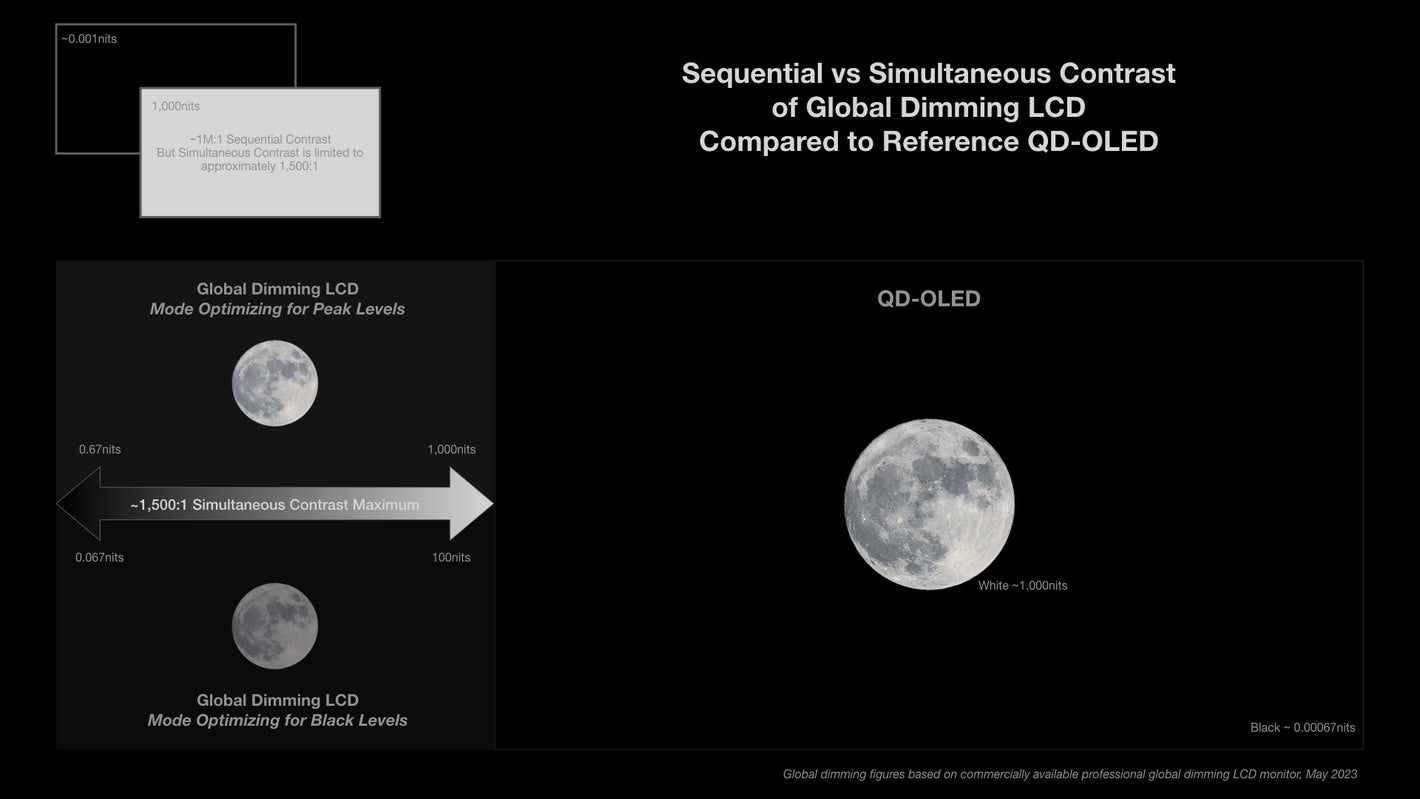
Advantages over Global Dimming LCDs
Reference grade HDR displays should be able to produce high simultaneous contrast, not just a bright image. Global dimming LCDs can either produce a bright image or a dark image, but cannot produce images that simultaneously have bright highlights and dark lowlights. Global dimming LCD specifications often quote high sequential contrast ratio figures, where a display’s peak luminance and and black level are measured at different times, but this can be quite misleading as simultaneous contrast is problematically low on these devices for any HDR content mastering use-cases. The XMP310C features class leading simultaneous contrast rendering both bright highlights and dark lowlights with incredible clarity and accuracy at the same time.
XMP310C Tech Specs

1080p (30/29.97/25/24/24PsF/23.98/23.98PsF)
1080i (29.97/25/24/23.98) 4:4:4 YCbCr, RGB
1080p (30/29.97/25/24/23.98) 4:4:4 YCbCr, RGB
720p (60/59.94/50) 4:4:4 YCbCr, RGB
- Level A & Level B supported
- Level B supports 2 x SMPTE
292M image format mapping
372M image format mapping
- RGB & YCbCr
4:4:4 1280x720p (60/59.94/50/30/29.97/25/24/23.98)
12 & 10bit 4:4:4 1920x1080i (60/59.94/50)
12 & 10bit 4:4:4 1920x1080p (30/29.97/25/24/23.98 + PsF variations)
12 & 10bit 2k (2048x1080)p (30/29.97/25/24/23.98 + PsF variations)
12 & 10bit 2K (2048x1080)p (60/59.94/50/48/47.95)
4K & UHD
Single-Link 12G
Single-Link 6G
Dual-Link 6G
Dual-Link 3G Square Division
Quad-Link 3G Level A Square Division
Quad-Link 3G Level B Square Division
Quad-Link 1.5G Square Division
10 & 8bit 4:2:2 3840x2160p (60/59.94/50/48/47.95/30/29.97/25/24/23.98)
12 & 10bit 4:4:4 4096x2160p (30/29.97/25/23/23.98) YCbCr & RGB
12 & 10bit 4:4:4 3840x2160p (30/29.97/25/23/23.98) YCbCr & RGB
*covers ~80% of Rec2020 color gamut